

A Beginner’s Guide to Understanding Sufism
Part of the Understanding Islam Series

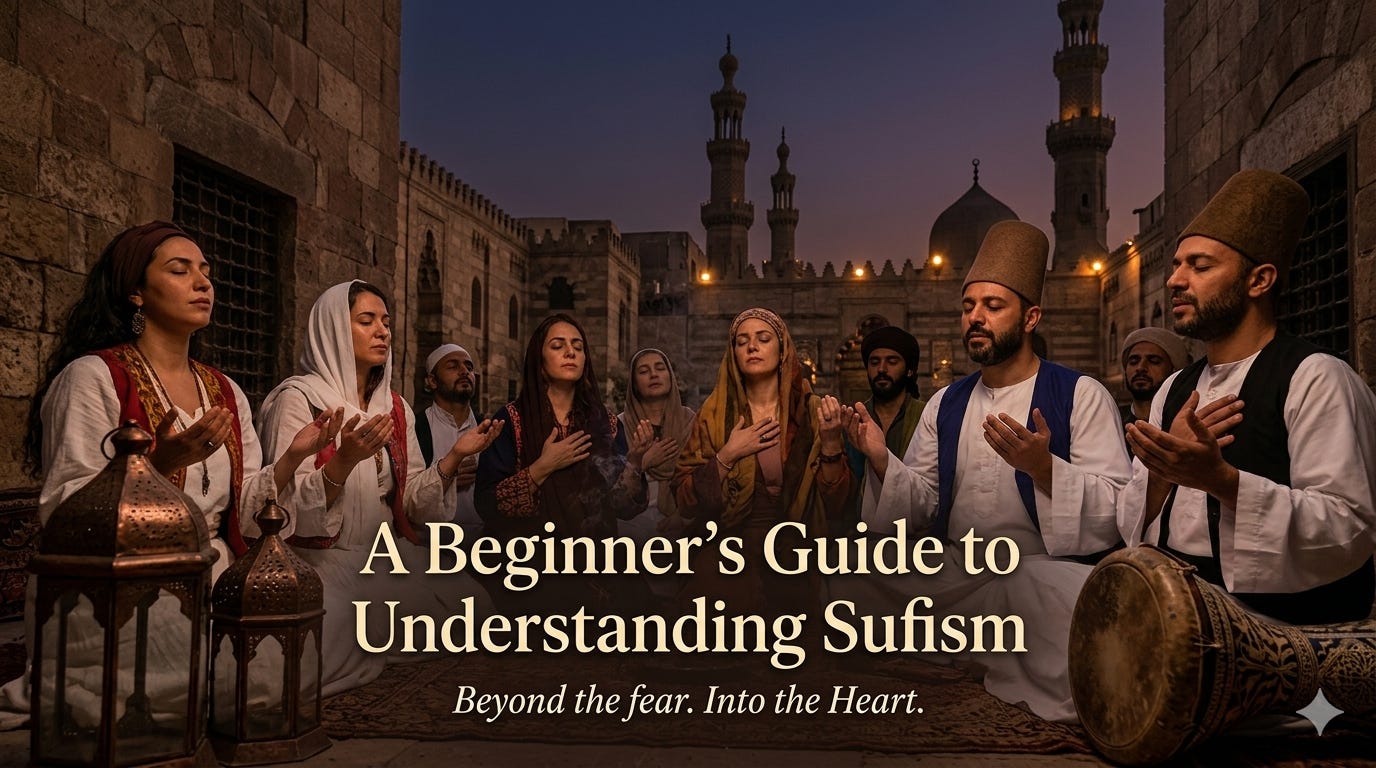
A couple of months ago, I was walking around the labyrinthine streets of Khan el-Khalili in Cairo, weaving through the stalls just as the call to prayer began to fade into a velvet evening sky. The air there is heavy and ancient—a thick, beautiful collision of roasting coffee, the metallic tang of copper-smiths’ hammers, and the sweet, resinous drift of aged oud from the perfume shops.
I remember feeling a strange sense of anticipation, my mind buzzing with the usual noise of the day, when I heard it: a rhythmic, low thrum that didn't come from the city's machines. It was a heartbeat made of goatskin drums and human voices. I followed that pulse into a dimly lit courtyard where men and women were swaying in a slow, tidal unison, their eyes closed, chanting a single name over and over until the very stones beneath my feet seemed to vibrate.
In that moment, my own racing thoughts simply stopped.
"What the heck is this?" I thought.
My internal monologue—the constant to-do lists and the analytical "author brain"—had finally hit the mute button. I realized I wasn't just watching a performance; I was witnessing a technology of the soul. It turns out, that "wild" mystical side of Islam involves midnight poetry, rhythmic breathing that induces a trance-like state, and even "spiritual intoxication."
This vibrant, soulful dimension is called Sufism.
Think of Sufism not as a different path, but as the beating heart of Islam. While the mainstream practice provides the "map" (the laws and rituals), Sufism is the "journey" toward a personal, direct experience of the Divine.
The Poet You Already Love
You’ve likely seen this famous quote on a greeting card or a mural:
"Your task is not to seek for love, but merely to seek and find all the barriers within yourself that you have built against it."
This was written by Rumi, one of the most popular poets in the West. But here is the secret: Rumi was a dedicated Sufi. Most of the heartbreakingly beautiful love poems that touch our souls so deeply were actually written as love letters to Allah (the Arabic word for God). To a Sufi, human love is just a "bridge" to help us understand the much larger, overwhelming love of the Creator.
This might sound familiar to those who have read the Bible. It is remarkably similar to the Song of Solomon, where intense, romantic language is used as a metaphor for the relationship between the soul and the Divine. Just as the Bible uses the imagery of a "bride" and "bridegroom," Sufis often refer to God as "The Beloved."
The Interior Decorators of the Soul
Most people know the "Five Pillars" of Islam—the outward actions like praying or fasting. Sufis don't ignore these; they just want to know what’s happening inside the person doing them. They focus on a concept called Ihsan, which means "excellence" or "beauty."
It’s the idea of worshipping God as if you can see Him. Sufis often point to a beautiful verse in the Quran that says God is "closer to you than your own jugular vein." Sufism is the practice of clearing away the "clutter" of the ego (the Nafs) to finally feel that closeness.
The Power of the Tongue
This isn't just about "thinking" happy thoughts. Sufis believe in the literal power of speech to reshape reality. Through a practice called Dhikr (remembrance), they chant the various names of the Divine. By repeating these specific sounds, they believe they are vibrationally aligning their physical bodies with the spiritual attributes of God—peace, mercy, and light. It’s the ultimate form of "speaking your truth" into existence.
One Tree, Two Main Branches
To understand how Sufism fits into the wider world, it helps to know about the two main "houses" of Islam: Sunni and Shia.
Long ago, a disagreement arose over who should lead the community after the death of the Prophet Muhammad (PBUH).
Sunnis (the majority) believed the leader should be elected from among the most capable followers.
Shias believed leadership should stay within the direct family of the Prophet Muhammad (PBUH), specifically through his cousin and son-in-law, Ali.
While they may disagree on history, Sufism is the connective tissue between them. You can be a Sunni Sufi or a Shia Sufi; the mystical "music" of the heart is played in both houses.
Common Myths vs. Reality
Q: Are Sufis "rebels" who don't follow Islamic rules?
A: Actually, most Sufis see their practice as the soul of the law. They believe the rules are hollow without love—like a body without a heart.
Q: Isn't Islam mostly about strictness and politics?
A: For over a thousand years, Sufism was the dominant way Islam was lived. It focuses on the "Greater Jihad"—which isn't a holy war against others, but the daily internal struggle to master one's own pride, anger, and ego.
The Global Language of Mysticism
Sufism rhymes perfectly with other spiritual traditions. Throughout history, there have always been people who weren't satisfied with just reading the "instruction manual"—they wanted to meet the Author.
The Catholic Mystics: Figures like St. Teresa of Avila spoke of the "Interior Castle." Their descriptions of losing oneself in God’s love are almost identical to Sufi writings.
The Quakers: Just as Sufis emphasize the "Inner Light," Quakers focus on the "Still Small Voice" found in silence.
Buddhism: The Sufi concept of Fana (the "extinction" of the self) shares a striking resemblance to Nirvana, where the individual ego dissolves into a greater universal truth.
Moving Beyond the Fear
For a long time, many in the West have been fed a narrow, distorted view of Islam. We have been taught to view this faith through a lens of fear, shaped by headlines rather than human connection.
But as we discover the world of Sufism—the "Tannoura" dancers of Cairo whirling in a kaleidoscope of color, the poets who wrote of Divine intoxication, and the scholars who saw science as a way to worship—that fear begins to dissipate.
We start to realize that we haven’t just been missing out on the beauty of the faith; we’ve been missing out on the ways it mirrors our own spiritual hungers. Sufism reminds us that beneath the labels runs a single thread of similarity. It teaches that the shortest distance between a human being and the Divine is through the human heart. When we prioritize love over dogma, we find that the "stranger" we were taught to fear is actually a brother or sister seeking the very same Light.
A Bit of Extra Knowledge: The word "Algebra" comes from the Arabic Al-Jabr. Many great scientists of the Islamic Golden Age were also Sufis, believing that understanding the patterns of the stars and numbers was a way to understand the Creator who made them.