

How do Muslims Pray?
Part of the Understanding Islam Series

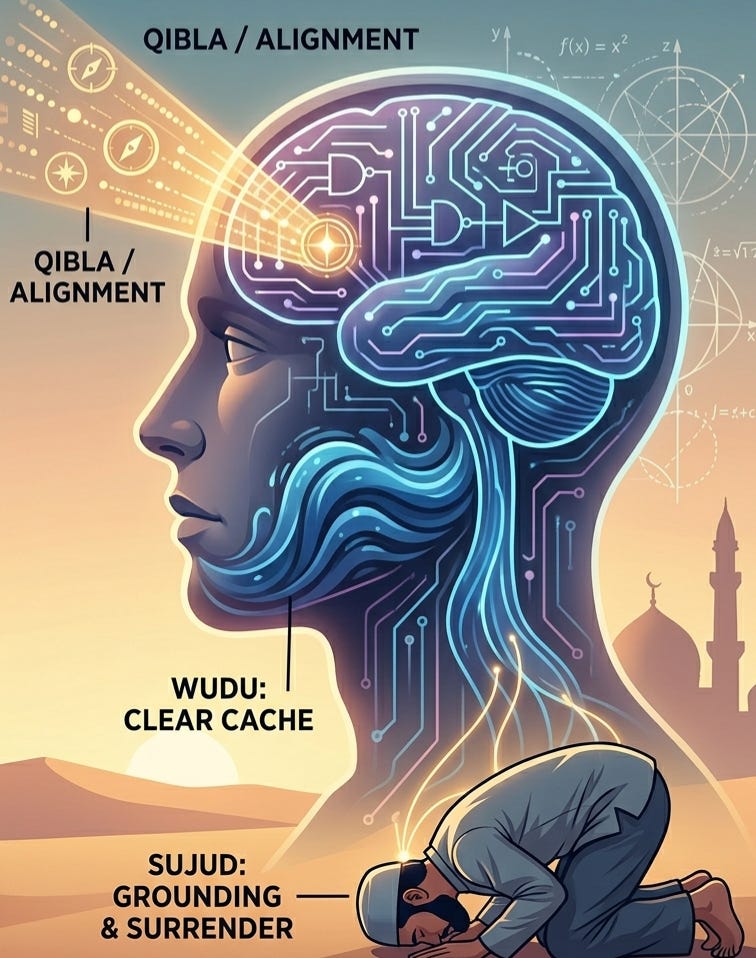
If you want to understand the psychological resilience of the Muslim world, you have to look at the rhythm of the day. In the West, we talk about "mindfulness" and "grounding" as luxury retreats for the elite. In the Islamic Operating System, this mental health maintenance is hard-coded into the schedule of every single person, from the billionaire CEO to the street vendor.
It is called Salah, and it is the ultimate "System Reboot."
The Original Posture: The Jesus Connection
One of the greatest investigative failures in the West is the visual disconnect between how we imagine Jesus and how he actually practiced his faith. In Western art, Jesus is often shown sitting in a quiet, Westernized pose.
But the data in the Gospels tells a different story. In Matthew 26:39, the text says: "And going a little farther he fell on his face and prayed." Falling on one’s face—prostration—is the exact movement of the Muslim Sujud. This isn't a "new" invention; it is the original, ancestral way of showing total submission. When you see a Muslim in prayer today, you are seeing the physical echo of Jesus, Moses, and the early prophets.
This link hasn't been lost everywhere. If you look at the Eastern Rites of Catholicism or the Orthodox traditions in Syria and Egypt, you will still see the "Great Metany"—a deep prostration nearly identical to the Muslim prayer. These ancient communities have kept the physical "Operating System" alive, proving that the body and the spirit were always meant to move together.
The Internal Compass: A Personal Observation
There is a mechanical beauty to this system that becomes visible only when you see it in action under pressure. During my time running volunteer efforts to assist displaced Palestinians in Cairo, my home became a hub of constant activity. These were people who had lost their homes, their security, and their worldly anchors.
Yet, when the call to prayer came, a remarkable shift would occur. No matter the chaos of the relief work or the weight of the displacement, there was a collective need to stop, to wash, and to find the Qibla—the direction of Mecca.
As an agnostic atheist, I watched this from the outside with profound respect. I saw that they weren't just performing a ritual; they were recalibrating. They were finding their "North." It became so central to the environment of my home that I eventually invested in prayer mats and mounted them on my wall, permanently aligned toward the Qibla. It turned a stranger's house into a sanctuary. It provided a moment of dignity and predictable structure in a life that had become entirely unpredictable.
The Muscle of Discipline: Moving Beyond the Monolith
One of the greatest misconceptions in the West is the idea that the Muslim world is a monolith of unwavering, automatic piety. We have a tendency to view every Muslim as a "devout soldier" of the faith, while we view Christians through a nuanced, human lens.
The reality is far more familiar.
Islam, like Christianity, is populated by people, not programs. Just as you have Christians who are deeply conservative and devout, you have those who are liberal, and frankly, those who are just "lazy." There are Muslims who never miss a prayer, and there are those who "skip mass"—who ignore the dawn call because they’d rather sleep in or are caught up in the grind of the day.
Prayer is not a reflex; it is a discipline.
Think of it like a fitness protocol for the soul. Some people are "Olympians" of the spirit, while others are just trying to make it to the "gym" once in a while. By acknowledging this, we strip away the "otherness" of the Muslim world. They aren't a robotic army; they are a community of individuals struggling with the same human tendencies toward procrastination and distraction that any Christian faces with Bible study or church attendance. The "Operating System" provides the ideal code, but the "hardware"—the human being—is often glitchy.
The Biocheck: Grounding and the Vagus Nerve
When we look at the physical movements of prayer, we see a sophisticated grounding exercise.
Wudu (The Wash): Before the prayer, you wash your face, hands, and feet. In investigative psychology, this is "Cold Water Immersion." It instantly lowers the heart rate and triggers the parasympathetic nervous system. It is a physical "Clear Cache" button.
Sujud (The Prostration): Physically, this brings the brain lower than the heart, increasing blood flow to the prefrontal cortex. Psychologically, you are grounding your ego into the earth, reminding yourself that you are a finite creature in an infinite universe.